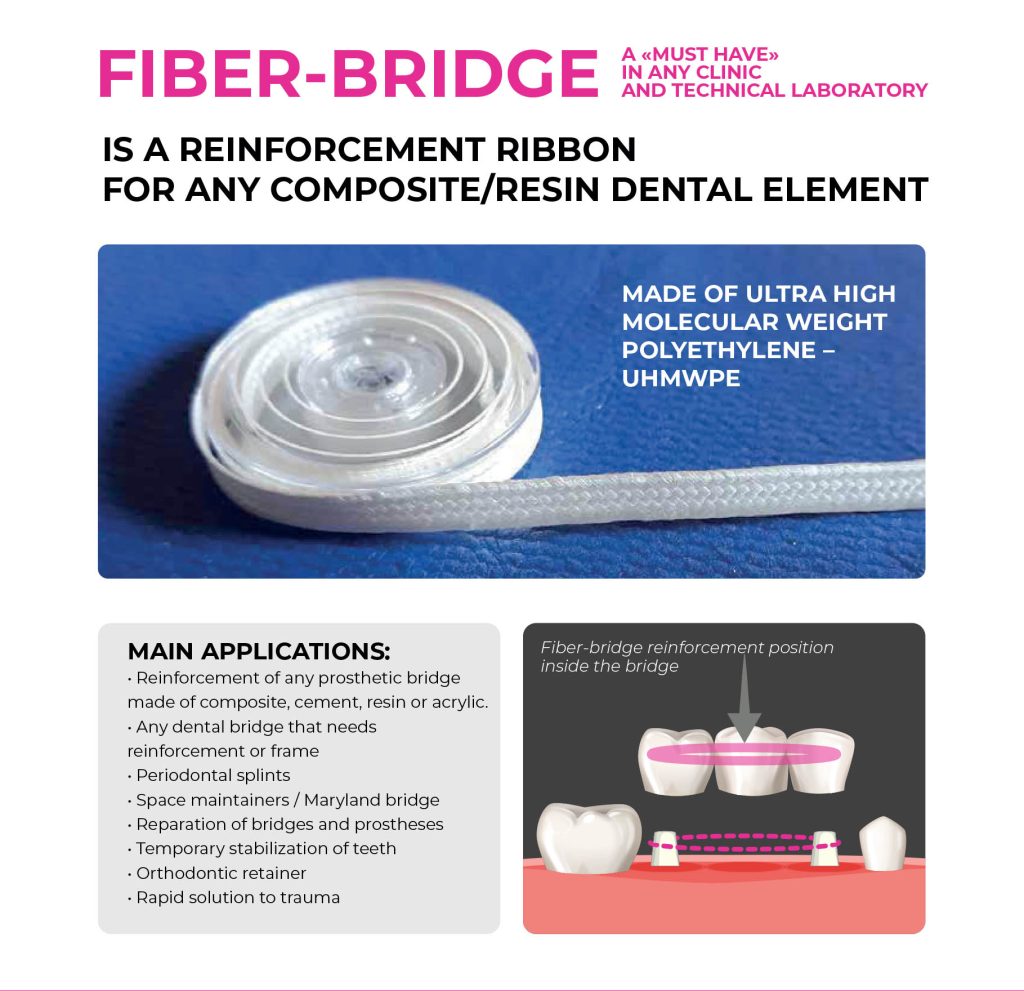
Yet, what are the key advantages of using FIBER-BRIDGE ultra-high molecular weight polyethylene (UHMW PE) ribbon for dental reinforcement, particularly in prosthetic and restorative dentistry:
1. Exceptional Mechanical Strength and Tenacity:
FIBER-BRIDGE UHMW PE fibers - integrated inside a resin-based polymerized prosthetic reconstruction- bestow high tensile strength and impact resistance. This offers several benefits:
• Fracture resistance: Provides excellent reinforcement against crack propagation in composite restorations or dentures.
• Flexural strength: Enhances the overall strength of the prosthesis.
• Durability: Maintains integrity over time under cyclic masticatory loads.
2. Excellent Integration Capability with Resin Composites:
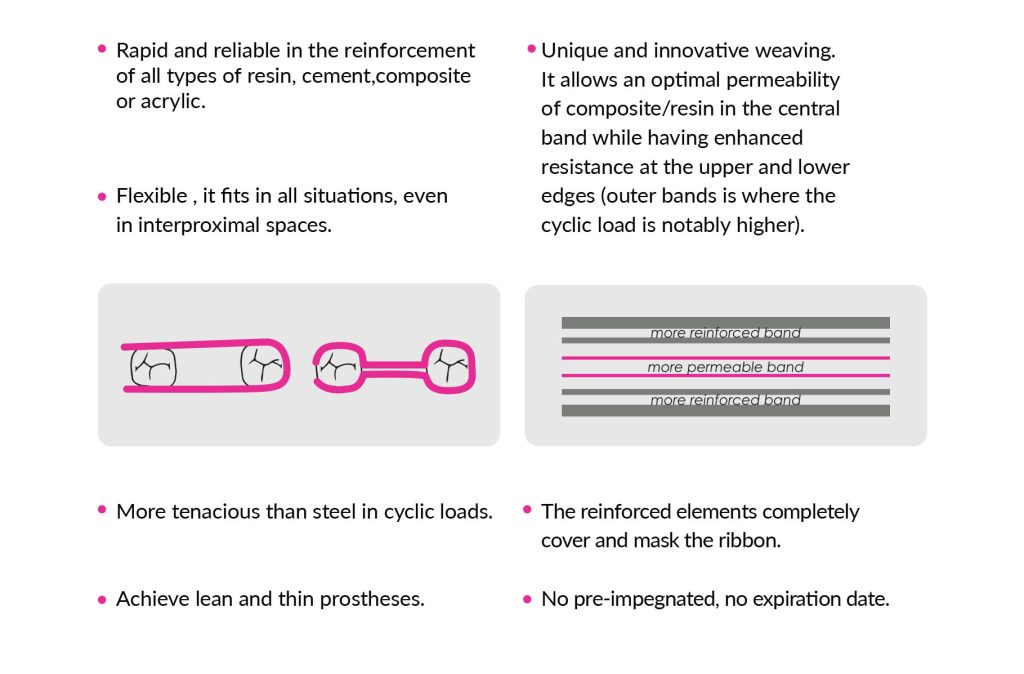
The threads interlacing of the Fiber-Bridge UHMW PE ribbon is ideal to enable strong micromechanical integration into the resin matrix:
• Stable integration: The permeability of the interlace of threads Prevents delamination and reduce the need of bonding.
• Versatility: A large range of applications: from bridges and reinforcement to splinting, and even reinforcement of endodontically treated teeth.
• Reconstruction longevity augmentation: expand the lifespan of direct or indirect composite restorations.
________________________________________
3. Biocompatibility and Adaptability:
UHMWPE is highly biocompatible, non-toxic, and chemically inert, making it ideal for intraoral use:
• Tissue friendliness: Notably UHMW PE does not provoke inflammation or irritation.
• Malleability: Easily conforms to the desired contour without memory, which is important for custom-fitting applications.
• Aesthetic preservation: The clear-whitish appearance blends well under composite favoring esthetics.
WHAT DOES FIBER-BRIDGE IN CLINICAL RECONSTRUCTIONS?
FIBER-BRIDGE UHMW PE ribbon provide superior strength, resin compatibility, and biocompatibility, making them a valuable tool in modern prosthodontics for reinforcing weakened structures. It extends the restoration longevity, and improves clinical outcomes in a minimally invasive way.
1. Fiber-Reinforced Composite (FRC) Bridges High tensile strength: Obtain a conservative reconstruction with adequate load-bearing capability
Sound structured armoring: Single, layered or combined embedded and invisible fiber-structure.
Adapatbility: pliable, flexible; manual impregnation that allows a chair side total customization.
WHAT BENEFIT?
Create adhesive bridges, without metal, avoiding invasive preps and preserving the tooth structure. A key factor of success especially in valuable younger or high-risk patients.
2. Reinforcement of Dentures (Partial or Complete)
Increase Fracture resistance:
In thin acrylic dentures the embedment of UHMWPE reduce the risk of fracture.
Thin yet strong:
It is crucial for patients comfort not to feel thick reinforced reconstructions.
No-memory effect: it stays in the shape one gives to it. Ideal for quick and easy lab adaptation.
WHAT BENEFIT?
Improve structural reliability of removable dentures. Reduce repair rates and improves long-term functionality, especially in patients with parafunctions
3. Splinting Mobile Teeth (Periodontal or Trauma Cases)
Flexibility with strength:
Unlike metallic wires, UHMWPE Fiber-Bridge is strong yet flexible. It allows physiological tooth movement while still providing stabilization.
Easy and Fast application:
Given its permeable interlacing, it can be bonded directly to the enamel or composite with minimal tooth preparation.
Excellent aesthetics:
whitish color make it easier for mimetic embedment, valuable especially in anterior teeth.
Long-term chemical stability- increase safety:
Does not corrode or degrade in the oral environment and avoid the bimetallism phenomenon.
WHAT BENEFIT?
Improve patient’s comfort, avoid soft tissue irritation and provide an ideal durability.