Why Irrigation Matters
Before Fiber Post Cementation?
Clinical Background
Successful fiber post cementation begins long before the post is placed. Endodontic treatment does not end with canal preparation. The condition of the root canal after instrumentation may significantly influence the subsequent restorative procedure. During root canal preparation, mechanical instruments shape the canal but do not completely clean all canal surfaces. Organic tissue remnants, bacterial debris and smear layer components may remain on the canal walls. For this reason, irrigation plays an important role not only during endodontic treatment, but also in preparing the root canal environment for adhesion and post cementation. Irrigation is not only about eliminating bacteria. It directly influences dentin surface condition, adhesion and the long-term stability of the restoration.
The Clinical Challenge
Effective irrigation requires clinicians to achieve several objectives simultaneously:
- Eliminate microorganisms
- Dissolve organic tissue remnants
- Manage the smear layer
- Preserve dentin integrity
- Create favorable conditions for adhesion
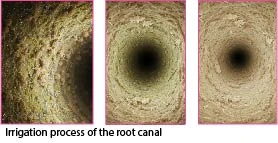
These goals are not always perfectly aligned. More aggressive irrigation protocols may improve cleaning efficiency but can also affect dentin structure if used improperly. More conservative approaches may preserve dentin but may not provide the same level of cleaning and disinfection. The challenge is to find a balance between cleanliness, disinfection and preservation of the remaining tooth structure.
The Biomechanical Challenge
Effective irrigation requires clinicians to achieve several objectives simultaneously: Adhesion inside the root canal differs considerably from adhesion in coronal restorations. The clinician works within a deep, narrow and anatomically complex environment where access and visibility are limited. Following instrumentation, the canal walls may contain:
- Organic tissue remnants
- Bacterial debris
- Smear layer
- Inorganic surface deposits
These residues may affect the condition of the bonding substrate and the interaction between dentin, adhesive systems, resin cement and fiber posts. The objective is to create a clean and suitable dentin surface while preserving as much healthy tooth structure as possible.
The Engineering Perspective
From an engineering perspective, irrigation is a surface preparation process. Different irrigation solutions perform different functions, and no single solution addresses all aspects of canal cleaning. Understanding the role of each solution helps clinicians design irrigation protocols that support both endodontic and restorative objectives.
Why Different Solutions Are Needed?
No single irrigation solution addresses all aspects of canal cleaning. Different solutions perform different functions within the root canal environment and are often used as part of a broader irrigation strategy.
Sodium Hypochlorite (NaOCl)
Sodium hypochlorite is widely considered the gold standard in endodontic irrigation. Its primary functions include:
- Dissolution of organic tissue remnants
- Antimicrobial activity
- Biofilm disruption
- Cleaning of areas beyond direct instrument contact
Because of its ability to dissolve organic material, NaOCl remains one of the most important irrigants in modern endodontics. However, sodium hypochlorite does not completely remove the inorganic component of the smear layer and should not be viewed as a complete cleaning solution by itself.
EDTA 17%
EDTA is commonly used to assist in the removal of the inorganic component of the smear layer created during instrumentation. Its primary functions include:
- Smear layer management
- Exposure of dentin tubules
- Removal of inorganic debris
- Preparation of the dentin surface for subsequent procedures
Unlike sodium hypochlorite, EDTA does not dissolve organic tissue. For this reason, EDTA and NaOCl are often used as complementary solutions rather than alternatives.
Chlorhexidine (CHX)
Chlorhexidine is sometimes incorporated into irrigation protocols because of its antimicrobial properties and substantivity. Its primary functions include:
- Broad antimicrobial activity
- Long-lasting antimicrobial effect (substantivity)
- Additional microbial control in selected protocols
Unlike sodium hypochlorite, CHX does not primarily dissolve organic tissue. Unlike EDTA, CHX does not independently chelate and remove the inorganic component of an established smear layer. Therefore, CHX should be viewed as a solution with a different clinical purpose rather than a direct replacement for either NaOCl or EDTA.
Organic and Inorganic Cleaning
Root canal contamination contains both organic and inorganic components. These components require different approaches.
Component
Organic tissue remnants
Inorganic smear layer components
Microbial contamination
Commonly Managed By
NaOCl
EDTA 17%
NaOCl and/or CHX
Because no single irrigant performs all functions effectively, clinicians frequently combine different solutions as part of a complete irrigation strategy. Understanding this distinction is important when preparing the canal for adhesive procedures.
Important Compatibility Considerations
⚠️ Sodium hypochlorite (NaOCl) and chlorhexidine (CHX) should not be brought into direct contact.
Direct interaction between these solutions may result in the formation of a brown precipitate. For this reason, clinicians who incorporate both solutions into the same irrigation protocol typically perform an intermediate rinse before introducing CHX. When multiple irrigation solutions are used, compatibility and sequence should always be considered as part of the overall clinical protocol.
Why Irrigation Affects Restoration Success
The goal of irrigation is not simply disinfection. The broader objective is to create favorable conditions for adhesion.
This includes:
- Cleaner dentin surfaces
- Better smear layer management
- Improved dentin tubule exposure
- More predictable interaction between dentin and adhesive materials
When canal cleaning is inadequate, the restorative procedure may become more challenging.
Potential consequences may include:
- Reduced bonding effectiveness
- Increased risk of debonding
- Microleakage
- Reduced long-term predictability
Conversely, proper irrigation may contribute to more favorable conditions for adhesive procedures and restorative success.
Why This Matters for Fiber Posts ?
Fiber post restorations rely heavily on adhesive principles. The clinical performance of a fiber post is influenced not only by the post itself, but also by the quality of the bonding interface created between dentin, resin cement and the post surface. When fiber post cementation is planned, particular attention may be directed toward:
- Canal cleanliness
- Smear layer management
- Dentin surface condition
- Irrigation sequence
- Material compatibility
- Adhesive protocol
A well-prepared canal creates more favorable conditions for adhesive bonding and may contribute to the long-term stability of the restoration.
Key Considerations
Successful post cementation depends on multiple interconnected factors, including:
- Irrigation protocol
- Canal cleanliness
- Smear layer management
- Dentin preservation
- Moisture control
- Adhesive protocol
- Resin cement selection
- Fiber post selection
No single material can compensate for deficiencies elsewhere in the restorative process. A successful outcome is usually the result of the entire workflow rather than any individual component.
Takeaway
Irrigation is more than a cleaning procedure.
It is a critical stage in preparing the root canal environment for adhesion and post cementation. By managing organic residues, smear layer components and microbial contamination through appropriate irrigation strategies, clinicians can create more favorable conditions for subsequent restorative procedures. Successful fiber post cementation begins with a clean and properly prepared canal. Understanding the distinct roles, limitations and compatibility of irrigation solutions is an important part of achieving predictable and durable restorative outcomes.