Why Fiber Posts Fail: Real Clinical Reasons
Clinical Background
Fiber posts have become a widely accepted solution for restoring endodontically treated teeth. Clinical studies generally report favorable survival rates when fiber posts are used appropriately. Nevertheless, failures can still occur in daily practice. Understanding why failures happen is important not only for selecting a post system, but also for improving the predictability of the entire restorative procedure.
The Biomechanical Challenge
Following the post space preparation, including irrigation, a fiber post restoration is not a single component.
It is a complex system consisting of:
- root dentin;
- adhesive interface;
- resin cement;
- fiber post;
- core build-up;
- final restoration.
Under functional loading, stresses are transferred through all of these components simultaneously.
As a result, the weakest interface often determines the mode of failure.
The Engineering Perspective
Many clinicians associate failure with the post itself. In reality, failures frequently originate at the interfaces surrounding the post rather than within the fiber post structure. The most common areas involved are:
Dentin ↔ Cement Interface
Bonding to root canal dentin remains technically challenging because of canal anatomy, moisture control and access limitations.
Cement ↔ Post Interface
Surface preparation, cement selection and clinical protocol can influence the quality of adhesion.
Coronal Structure
The amount of remaining tooth structure and ferrule design often have a major influence on long-term restorative stability. From an engineering perspective, the performance of the system depends on the compatibility of all components rather than on the strength of a single material.
Clinical Applications
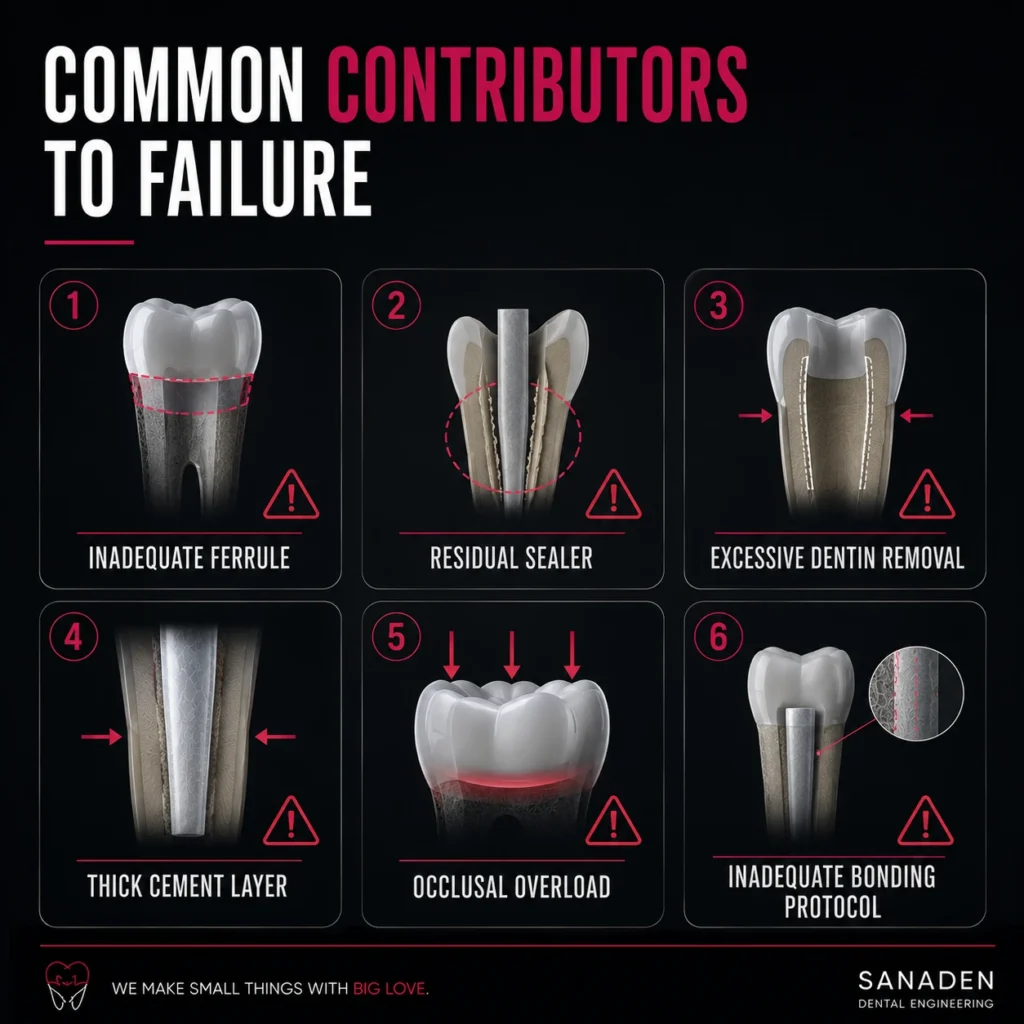
When analyzing post failures, clinicians should evaluate the entire restorative system. Common contributing factors may include:
Inadequate Canal Cleaning
Residual debris or smear layer may interfere with adhesive procedures.
Adhesive Protocol Variations
Moisture control, curing conditions and material compatibility can influence bonding performance.
Limited Ferrule
Insufficient coronal tooth structure may increase biomechanical demands on the restoration.
Functional Overload
Occlusal forces, parafunctional habits and unfavorable loading conditions may contribute to long-term complications.
Post Selection
Post geometry, diameter and taper should be selected according to anatomy and restorative requirements.
Key Considerations
Successful fiber post restorations depend on:
- Appropriate case selection
- Adequate ferrule design
- Conservative dentin preservation
- Proper post-space cleaning
- Controlled adhesive procedures
- Compatible restorative materials
- Functional occlusal design
No single factor alone determines success or failure.
Takeaway
Fiber post failure is rarely related to the post alone. In many situations, failure involves the interaction between dentin, cement, adhesive procedures, restorative design and functional loading. The goal is not simply to choose a stronger component, but to create a stable and compatible restorative system.